
 In today’s competitive industrial landscape, understanding the full scope of power quality and its impact on your operations can make the difference between thriving and merely surviving.
Studies performed in 2015 presented that poor power quality was costing the European economy up to a staggering €150 billion annually, according to the Leonardo Power Quality Initiative. U.S. losses ranged from $119 billion to $188 billion, according to research by the Electric Power Research Institute (EPRI).
It is not hard to see how the numbers add up. Just consider what an outage of a day or two would cost your company. For some, an outage of even an hour can take a significant toll.
Many companies do not fully understand all the various types of power disturbances that can threaten their operations. While protecting against events like power surges and equipment failures is crucial, many more subtle power disturbances can be equally disruptive.
Common Types of Power Disturbances
- Power Interruptions
Complete loss of supply voltage or load current, ranging from instantaneous to sustained, causes data loss and operational downtime. - Undervoltage (Sags)
Short-term reductions in AC voltage due to system faults or heavy startup currents may potentially damage equipment over time. - Overvoltage (Swells)
Short-term increases in AC voltage, often unnoticed, cause long-term damage to electrical contacts and semiconductors. - Harmonics
Variations affecting the wave shape of voltage or current, including harmonic distortion and noise, disrupt sensitive electronic equipment. - Transients
The most damaging disturbances – transients, often caused by lightning, poor grounding, or inductive load switching – can lead to data corruption, operational malfunctions, and equipment damage. - Resonance
Harmonics can lead to resonance with other network components, such as capacitors, which can amplify distortion and cause severe damage. - Voltage Fluctuations (Flickers)
Small, random changes in voltage cause issues such as flickering lights and equipment malfunctions.
Click anywhere on the slide below to see the adverse effects of poor power quality:
There is a common misconception that power quality problems are caused by utility companies – the most revealing finding by EPRI is that 80 percent of power-quality disturbances are generated within a facility.
Most of the voltage and frequency irregularities, among other power-quality problems, are created by equipment and processes within the facility’s own operations. The reality is that the majority of power quality issues are caused by the operational process or arrive from faulty equipment or installation. The rectifiers and power electronic converters in today’s technologies allow motors or LED lighting systems to operate more efficiently; however, they are major sources of unpredictable non-linear loads and harmonic currents.
This means that the solutions to any power quality problems your facility might be experiencing likely lie within your control.
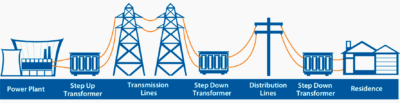
There is growing evidence that power networks are facing significant challenges due to the world’s transition to operate more efficiently. This is causing an increased strain on the grid, leading to power supply problems in many local areas. The main issue is that the distribution networks were designed a century ago to handle relatively predictable loads. Now, they are dealing with massive amounts of new, high-power non-linear unpredictable loads. Existing cables and substations in many networks are simply not large enough to handle the increased power flow. Upgrading this infrastructure requires substantial long-term investment.
Power quality mitigation is a quite complex process. Evaluating power quality means considering the entire production process, focusing on minimizing overall costs. This might involve cost-effective strategies, such as protecting only the most vulnerable equipment in a large-scale operation, ultimately reducing the total investment on power quality management.
Diagnosing power quality issues requires specialized equipment and expertise. It’s not always straightforward and can involve detailed analysis to pinpoint the exact cause and solution – an area in which IVY Consulting has extensive expertise.
So, find out why you should use us!